From Problem to Solution
From Problem to Solution
I often struggle to organize and prioritize my ideas. Time is precious, and I’d prefer to spend it with love ones, relaxing, and practicing self care, but my time spent tinkering is also very important to me. Today, I did some semantic modeling to understand the motivation for the work I do in my free time, and I came up with this model:
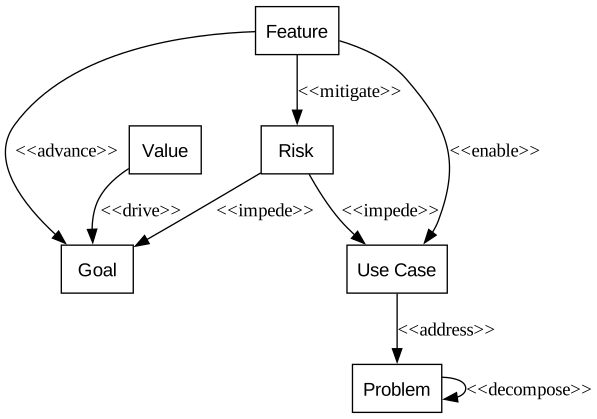
In this model, a Feature is an increment of work; a thing that I spent time to accomplish. My takeaway was that there are three motivations for completing Features:
- To enable a Use Case.
- To mitigate a Risk.
- To advance a Goal.
I think that completely captures the solution space. I won’t explain every relationship in the diagram, since the relationships speak for themselves. There are a couple of details not represented in this diagram that deserve a little explaining, however.
Solvable Problems
This model exists so that I can focus my creativity to develop solutions to problems. The starting point is to recognize when a need arises and to identify the next step. The fundamental assumption of this process is that the Problem statement is the genesis of the product–that there exists some hypothetical product or process which is capable of addressing the need underlying the problem statement. Obviously, some problems can’t be solved with products or processes. I’m sure you have no trouble thinking of one. Some of these problems can be decomposed further into problem statements that do uphold this assumption, however.
The Genesis of Product
In my last post, I wrote about the source of requirements. You might notice that I only listed two sources of requirements there, but there’s a third thing here that motivates my work–Goals, which are driven by Values. This is a different kind of value than the value-driven design I proposed in my last post. I hope you won’t find me naive if I say that values are generally not a motivating factor in industry. My employer defines a set of values, but they only inform how I accomplish my work. They do not dictate what I work on. Conversely, I as an individual can form a value statement around the accessibility and quality of open source software. That’s enough justification to make contributions to the Linux kernel. I’d be surprised if businesses were making decisions in the same way. That’s why I included it here.
Use Case Subtypes
I often work with a subtype of Use Cases with which any software developer ought to be familiar: User Stories. I chose to omit it from the diagram to minimize visual noise. Here, I consider a user story to be a subtype of a use case because it has more constraints than a use case often does: a user story contains the use case built into its statement, and includes the user’s motivation. The latter is usually omitted from a canonical Use Case description. It may be the case that the next logical step, after capturing a problem statement, may be to conceive a User Story that addresses the underlying need, especially if the solution to the problem involves a great amount of technical detail not suitable for a high-level use case, or if the motivation isn’t inherently clear from the solution.
Risk Subtypes
There are also two implicit subtypes of Risk not captured in the model.
A Program Risk is a risk that I will fail to implement my objective. For example, if I’m working with a new technology to implement a feature, there may be a chance that I misunderstand the technology and fail to implement the product in a useful manner. I may choose to mitigate this risk by doing some investigation or prototyping to burn down the risk.
I’ll refer to the other type of risk as System Risk. This is the risk that a user, while acting on my product to achieve their goal, will fail or experience harm. These are usually mitigated with tools like invariants, which enforce rules on the ways that a user can interact with a product based on its state, or with architectural features, which support a qualitative architectural characteristic, such as quality or reliability.
Both kinds of risk impede my Goals and Use Cases, which is why I didn’t draw the distinction in the model.
Conclusion
My plan is to refer back to this model from time to time, to calibrate my process for tinkering. The goal here was not to create a new process, but to model the process I’m already using, to be able to understand and reason about it more effectively in the future. I’ll provide updates in the context of my projects in future posts!